If you read the previous piece, you now know procrastination is layered. It is not a single flaw.
But knowing why you procrastinate does not stop you from doing it tomorrow morning. You do not break procrastination by thinking about it longer. You break it by interfering with the cycle.
That means changing how you respond to discomfort, how you structure your environment, and how you manage your energy.
Now let’s be real with each other. There is no permanent victory here. Procrastination is not something you conquer once and archive. It is part of the human operating system.
It will resurface under stress, fatigue, or pressure. It is an ongoing battle till we part ways with our bodies.
Your job is not to eliminate it permanently. Your job is to make responding to it easier and more efficient each time it shows up.
1. Break the Shame Loop First
Do not try to fix procrastination with more pressure. That usually backfires.
If you sit down to work and feel resistance, your nervous system is already signaling discomfort. When you respond by attacking yourself, you increase the stress load.

Now the task carries anxiety and shame. Your brain will try to repair that mood, which means more delay.
Another angle to consider is that when you say, “I am a procrastinator,” you fuse behavior with personality. That makes change harder because identity resists alteration. Procrastination is a habit, not a character trait.
Studies show that self forgiveness reduces future procrastination. When shame decreases, avoidance decreases. Breaking the cycle starts with lowering emotional intensity.
When you catch yourself procrastinating, pause for one minute. Ask yourself, “What feels uncomfortable about this task?”
- “I am afraid this will look amateur.”
- “I do not know how to structure this.”
- “I am tired.”
- “I will never make a presentation as good as Daniel’s. Fuck that guy. He probably has no social life.”
Once the emotion is visible, it becomes manageable. You lost 30 minutes. Fine. Reset. There is no need to be perfect. Emotional regulation comes before discipline.
2. Lower the Stakes So You Can Move
If you think about it, perfectionism is mostly just ego protection.
When you tell yourself you need to “do this properly” or “make it great,” what you often mean is that you are afraid of producing something imperfect and having that imperfection reflect back on you.
If you try fully and still fail, the ego has nowhere to hide. So it delays. As long as the work remains unfinished, your potential to be great remains.
Lowering the stakes is a legit strategy you can leverage. The first shift is from output goals to input goals.
Instead of “This article needs to perform well,” try “I will write for 45 minutes.”
Instead of “This presentation must impress everyone,” try “I will outline the first three slides.”
Output goals create pressure because you cannot fully control them. Input goals lower resistance because they are entirely within your control.
Then apply Minimum Viable Action.
Break the task down until the first step stops feeling intimidating.
- If writing for 45 minutes feels intimidating, write for five.
- If five feels like too much, write for one minute.
- If one minute feels like a huge pain (really?), open the document and type a single sentence.
Going back to strategy, the goal is to reduce psychological threat. When a task feels too large relative to your current energy or skill, your nervous system interprets it as danger. It freezes.
Minimum Viable Action bypasses that freeze response. It tells the brain, this is manageable. Once you begin, momentum often carries you further than you planned. And if it does not, you still moved.
You do not need to feel confident to begin. You need the first step to feel safe enough to take.
Small wins build momentum. Momentum builds confidence. Confidence reduces resistance.
3. Start Before You Feel Ready
If you wait to feel like a disciplined person before you act, it’s gonna be a long wait.
Do not operate from the mindset that belief comes before action. In reality, action reshapes belief. When you move, even slightly, you give your brain proof that the task is survivable. That proof lowers resistance the next time.
This is why starting matters more than finishing. When resistance shows up, do something physical immediately.
Stand up. Walk to your desk. Open the file. Set a timer for one minute.
Yes, one minute. One minute won’t change your life. It is too small for your brain to argue with.
Procrastination lives in hesitation. The longer you sit and think, the more dramatic the task becomes.
- “I should feel more ready.”
- “This needs to be really good.”
- “I’ll just make coffee first.”
- “Actually, let me clean the kitchen. Productivity is productivity.”
Now you are reorganizing the spice rack instead of writing the proposal. Starting rituals exist to shut down that negotiation.
If you feel stuck, count down slowly: 5, 4, 3, 2, 1. Then move physically. The countdown interrupts rumination and forces your brain to switch from overthinking to execution.
Once you begin, reduce the commitment further. Tell yourself, “I will work for five minutes.” Or, “I will write five sentences.” Or, “I will do five pushups.”
When you feel the urge to quit, extend it by five more. Five more lines. Five more minutes. Five more reps.
Often the first five are the hardest. After that, the nervous system settles. The monster you imagined shrinks back into a normal task. And even if you stop after five, you still win.
You proved you can start without waiting for the perfect mood, the perfect playlist, or the perfect planetary alignment. No, your project is not stalled because Mercury is in retrograde again.
You do not become disciplined by thinking about discipline. You become disciplined by accumulating small acts of evidence that you can move when you would rather scroll.
4. Design the Environment. Don’t Rely on Discipline
Procrastination will win because it is easier. Scrolling requires no setup. Deep work requires preparation. Guess which one your brain prefers.
So invert them. Make starting simple. Make delaying inconvenient.
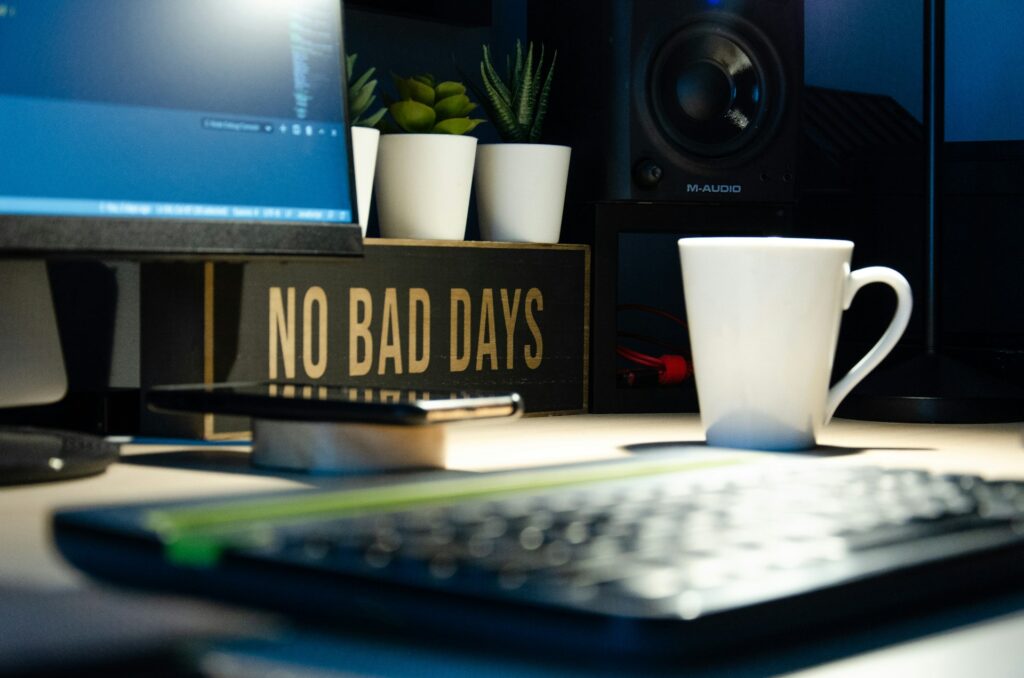
If you want to write, keep your document open. Keep a notebook on the desk. Remove everything else.
If you want to train, lay out your clothes the night before. Shoes visible. Bag packed.
And if you want to focus, your phone cannot be within reach. Yes, that feels dramatic. That is the point.
Modern platforms operate on variable reward loops, the same mechanism used in slot machines. Every scroll carries uncertainty. That uncertainty keeps dopamine active. Your brain learns to crave the next hit.
You will not out argue that system with positive affirmations. Leverage restrictions. Use app blockers. Set internet shutdown times. Work in airplane mode.
Then add structure. Use the same workspace for the same task. When you enter that space, your brain begins to associate it with a specific behavior. Over time, resistance decreases because the cue is consistent.
This is basic behavioral conditioning. The brain links cues with actions. When the cue repeats consistently, the behavior requires less conscious effort. Stop wasting willpower and energy on deciding. Just start executing.
Studies on habit formation show that repetition in a stable context strengthens automaticity. The less you rely on decision making, the less energy you burn resisting yourself. Choose the path of least resistance.
5. Protect Your Energy Like It’s Capital
Imagine trying to win a match after staying awake all night.
That is how many people approach their goals. They try to write when exhausted. They try to build when underfed. They try to focus after six hours of scrolling and constant notifications.
Then they conclude they lack discipline. Willpower is fragile under stress. When the body perceives threat or depletion, it shifts into conservation mode. Creative thinking narrows. Risk tolerance drops. Avoidance increases.
Sleep 7 to 9 hours. Protect it like a business asset. Eat in a way that keeps your energy stable. If your breakfast causes a spike and crash, your afternoon will collapse.
Automate small decisions. The brain tires like a muscle. Do not waste its strength on trivial choices.
Structure your day so creative work happens when your energy is highest. Do not swing like a pendulum between deep thinking and shallow tasks every ten minutes.
There is a reason well rested teams outperform exhausted ones. In several work trials, reduced hours paired with proper rest led to significant productivity gains. More energy often means better output in less time.
Discipline is easier when your biology is cooperating. Protect the foundation, since everything else sits on top of it.
6. Redefine a “Good Day”
Here’s a simple truth – if you do not define success, your brain will default to “busyness”.
Procrastination thrives in vagueness. If you cannot see progress, your brain looks for stimulation instead. So make progress obvious.
There is strong evidence from behavioral psychology that perceived progress is one of the strongest drivers of motivation. When progress is unclear, motivation drops. When progress is visible, it increases.
So engineer small wins deliberately.
Define one priority, then complete it early in the day if possible.
Two to three hours of real deep work is often enough to move the needle. Studies on attention show that sustained high focus rarely lasts beyond that anyway. Expecting eight flawless hours is fantasy.
Once that block is done, you have already won. The rest of the day can wobble a little and it will not matter. You can handle small tasks without the quiet panic that nothing meaningful happened.
This Is On You Now
Now you understand that procrastination is predictable.
- Your nervous system avoids discomfort.
- Your ego avoids exposure.
- Your brain prefers fast rewards.
- Your body shuts down when depleted.
And now that you see it clearly, the responsibility shifts.
- You cannot blame mood.
- You cannot blame planets.
- You cannot blame “not feeling inspired.”
You must design the conditions you work in. You must lower the stakes, and above all, you move and take any kind of action, consistently.
Procrastination is a systems problem. But change is a responsibility problem. I wrote more about that here.